The dark-haired girl on the right with the impish smile, her name was Eddie Lou, she was about 8 years old when this photo was taken in 1909. The picture was taken at the Tifton Cotton Mill, Tifton, Georgia. The girls worked there.
The photograph was taken by Lewis Hine, who visited factories such as this mill and took photographs of the children who worked there as evidence for the National Child Labor Committee (NCLC). At times, Hines had to disguise himself, even posing as a bible salesman in order to get on company grounds because as a photographer he was prohibited.
"In the early 1900s, Hine traveled across the United States to photograph preteen boys descending into dangerous mines, shoeless 7-year-olds selling newspapers on the street and 4-year-olds toiling on tobacco farms. Though the country had unions to protect laborers at that time — and Labor Day, a federal holiday to honor them — child labor was widespread and widely accepted. The Bureau of Labor Statistics estimates that around the turn of the century, at least 18 percent of children between the ages of 10 and 15 were employed," according to the Washington Post.
Child laborers in glasswork. Indiana, 1908. Library of Congress
Many industries hid the fact that they employed children. They took advantage of poor families, such as Eddie Lou's family. Eddie Lou's father had died and left her mother with 11 children and no income. Her mother was forced to work at the cotton mill for $4.50 a week. Eddie Lou and four siblings also worked there and they were all together paid $4.50 as well. Eddie Lou and her youngest siblings would eventually be sent to an orphanage because her mother wasn't able to provide for them.
Hine had been a teacher, but he left the teaching profession when he realized a camera could be used as an educational tool for social reform. He became a photographer for the NCLC to help change the laws and end child labor.
It was sometimes a dangerous job, and Hine was frequently threatened by factory police and foremen. He visited factories, sweat shops, and other businesses touted as the pillars of the community. He would find the young children, like Eddie Lou, working at these places, toiling their childhood away.
Hine also photographed immigrants at Ellis Island at a time when popular opinion of immigrants wasn't good. According to The Tenement Museum, which preserves and interprets the history of immigration, Hine "sought to humanize immigrants, to make their journeys, their wants, their struggles indistinguishable from any American".
Hines' photographs would be instrumental in changing the child labor laws in the United States. If it were not for him and his photographs, industries would have been able to hide the immorality of child labor and would have been able to continue exploiting children. If it were not for him, children today, instead of enjoying a three day weekend, would probably be working.
“It was Lewis Hine who made sure that millions of children are not working today,” said Jeffrey Newman, a former president of the New York-based committee."
According to the Washington Post, Though there had been investigations that attempted to expose these circumstances in the past, the industry simply dismissed those reports as — the term they would use today is — ‘fake news,’ ” said Hugh Hindman, a historian of child labor. “When Hine comes along and supplements the investigations with pictures, it creates a set of facts that can’t be denied anymore.”
Hine didn't have to do what he did, yet he did. At the time, he was one of the most hated men in America because of his photographs. He would be threatened with violence and even death. But, he felt it was his moral obligation to do what needed to be done, what some refused to do, what others were not capable of doing. Some inferred that it was unpatriotic to do what he did. Others, however, would realize later that what he did was one of the most patriotic things you can do.
According to the Washington Post, back then "there was no such thing as going viral in the early 1900s. The spread of Hine’s photos and the reform that they inspired was extremely slow. The Fair Labor Standards Act, the federal law that would prohibit most employment of minors, wasn’t passed until 1938. Hine died two years later — long before his work would be recognized for the impact it had."
People would forget about Lewis Hine and the work he did. He died at the age of 66.
But his photographs remain a reminder and a testament to his work, to his dedication to do what was right.
Jacques-Louis David, (born August 30, 1748, Paris, France—died December 29, 1825, Brussels, Belgium), the most celebrated French artist of his day and a principal exponent of the late 18th-century Neoclassical reaction against the Rococo style. Here he is looking very romantic and revolutionary. 1794
David won wide acclaim with his huge canvases on classical themes (e.g., Oath of the Horatii, 1784). When the French Revolution began in 1789, he served briefly as its artistic director and painted its leaders and martyrs (The Death of Marat, 1793) in a style that is more realistic than classical. Later he was appointed painter to Napoleon. Although primarily a painter of historical events, David was also a great portraitist (e.g., Portrait of Mme Récamier, 1800).
Death Of Marat. 1793
Napoleon admired The Intervention of the Sabine Women and saw possibilities for self-aggrandizement in the talent displayed. Soon David, without acquiring political office, was again a government painter, first under the Consulate and then, after 1804, under the Empire. He was not, however, the only prominent Frenchman to move from the Jacobin left to the Bonapartist right, and he had evidently always been a worshiper of historical heroes. His most important Napoleonic work is the huge Consecration of the Emperor Napoleon and the Coronation of Empress Joséphine on December 2, 1804 (1805–07), sometimes called Coronation of Napoleon in Notre-Dame; in it Neoclassicism gives way to a style that combines the official portraiture of the old French monarchy with overtones—and occasional straight imitation—of the masters of the Italian Renaissance.
Napoleon in his study
This picture was followed in 1810 by the large Napoleon Distributing the Eagles and in 1812 by The Emperor Napoleon in His Study at the Tuileries, a sharply perceptive portrait notwithstanding its conspicuously propagandistic intention.
After the fall of Napoleon in 1815, David was exiled to Brussels. Cut off from the excitement and stimulus of the great events he had lived through, he lost much of his old energy. Toward the end of his life, he executed, probably with considerable help from a Belgian pupil, François-Joseph Navez, one more remarkably convincing portrait: The Three Women of Gand.
Gustave Caillebotte (1848-1894) is the “unknown Impressionist.” If Paul Cézanne, Edgar Degas, Claude Monet and Pierre Auguste-Renoir are synonymous with the movement, Caillebotte remains unfamiliar. Yet Caillebotte’s masterpiece, “Paris Street, Rainy Day” (1877), with its chic Parisians under their arching umbrellas, carefully disposed against a vast expanse of shiny, wet cobblestones, narrow streets zooming into infinity behind them, is admired by countless art lovers, even by many who don’t know the artist’s name. And, it turns out, Caillebotte played a vital role in the early history of Impressionism, in many different ways.
Yet this obscurity isn’t surprising. For a remarkably long time, Caillebotte, a wealthy man who had no need to work (or sell his paintings), was discussed primarily as a patron of his adventurous friends, the Impressionists—someone who bought their pictures, paid their bills, lent them money, and was occasionally stimulated by their example to try his own hand, as an amateur. His controversial (at the time) donation of his collection to the French state, after his death, eclipsed his achievements as a painter.
It was not until the 1950s and 1960s that the dealer Georges Wildenstein began presenting Caillebotte’s canvases as worth considation, and not until 1976 that a monographic museum show, organized by Kirk Varnedoe, claimed the painter for serious scrutiny. As a result, Caillebotte had an important place in a 1986 exhibition celebrating the centennial of the last Impressionist exhibition organized by the artists themselves. Other significant exhibits followed, most notably, in 1994, a full-scale retrospective, seen at the Grand Palais, Paris; the Art Institute of Chicago; the Los Angeles County Museum of Art; and the Royal Academy, London.
That exhibition gave us Caillebotte at his best, pitting his sense of dramatic structure against his observations of his family and friends, and the places they inhabited and frequented: bourgeois interiors; the boulevards and apartment buildings recently constructed under the direction of Napoleon III’s prefect, Baron Haussmann; a massive bridge over the rail lines approaching the Gare Saint-Lazare; family country houses and their environs. That exhibition provoked intense nostalgia for a time and place we’ve only read about, bringing the first volumes of Marcel Proust’s “In Search of Lost Time” to vivid life.
Considerably younger than the better-known Impressionists, Caillebotte obtained a law degree and then studied painting with some of the leading conservative artists of the day.
His first submission to the official Salon, “The Floor Scrapers” (1875), was not accepted because of its “vulgar” subject matter—workmen, stripped to the waist—not to mention its tipped perspective and the exaggerated length of the kneeling workmen’s bare arms, extended toward us as they pull their tools along the floor. (The picture apparently shows preparations for Caillebotte’s new studio in the family home.) The official art world may have rejected “The Floor Scrapers,” but it interested a group of young progressive, anti-establishment painters. They persuaded its author to join them and, in 1876, Caillebotte participated, along with Degas, Monet, Renoir and Alfred Sisley, among others, in the second Impressionist exhibition.
Over the next six years, Caillebotte was intimately connected to the Impressionist circle. Although he never fully replaced clear, Degas-inspired outlines and eloquent shapes with loose paint handling or abandoned deep space for an all-over fabric of broken strokes in his paintings, he took part in their exhibitions, organized and financed the shows, and bought his colleagues’ work.
The Washington installation evokes a gallery in the 1877 Impressionist exhibition, which Caillebotte organized, selected and arranged. As in the original show, “Paris Street, Rainy Day” is flanked by two related street scenes, one of house painters on ladders, working on a shop front, and “The Pont de l’Europe” (1876), with its vast bridge girders, strolling Parisians, and a purposeful dog. All three paintings are remarkable for plunging perspectives and a sense of immediacy, characteristics that have led to comparisons with photography—yet another aspect of modernité.
The portraits of family and friends, almost all male, and the occasional self-portrait, play penetrating likenesses against sometimes preposterous furniture, often to fine effect, and sometimes with surprises. A group of well-dressed men playing bezique turns out to have provoked Cézanne’s celebrated card players a decade later. Caillebotte’s only nudes, both large, one male, one female, are as far from classical prototypes as you can get, especially the male, seen from the back, toweling off after a bath. Images of food stuffs, family country houses, and boating scenes—Caillebotte was an accomplished sailor who increasingly devoted himself to boats, rather than painting, before his early death—round out the portrait of this sharp-eyed observer’s world. Even a wall of four apparently straightforward views of fields at different seasons prove to document the most up-to-date “industrialized” agriculture of the time. Modernité, indeed.
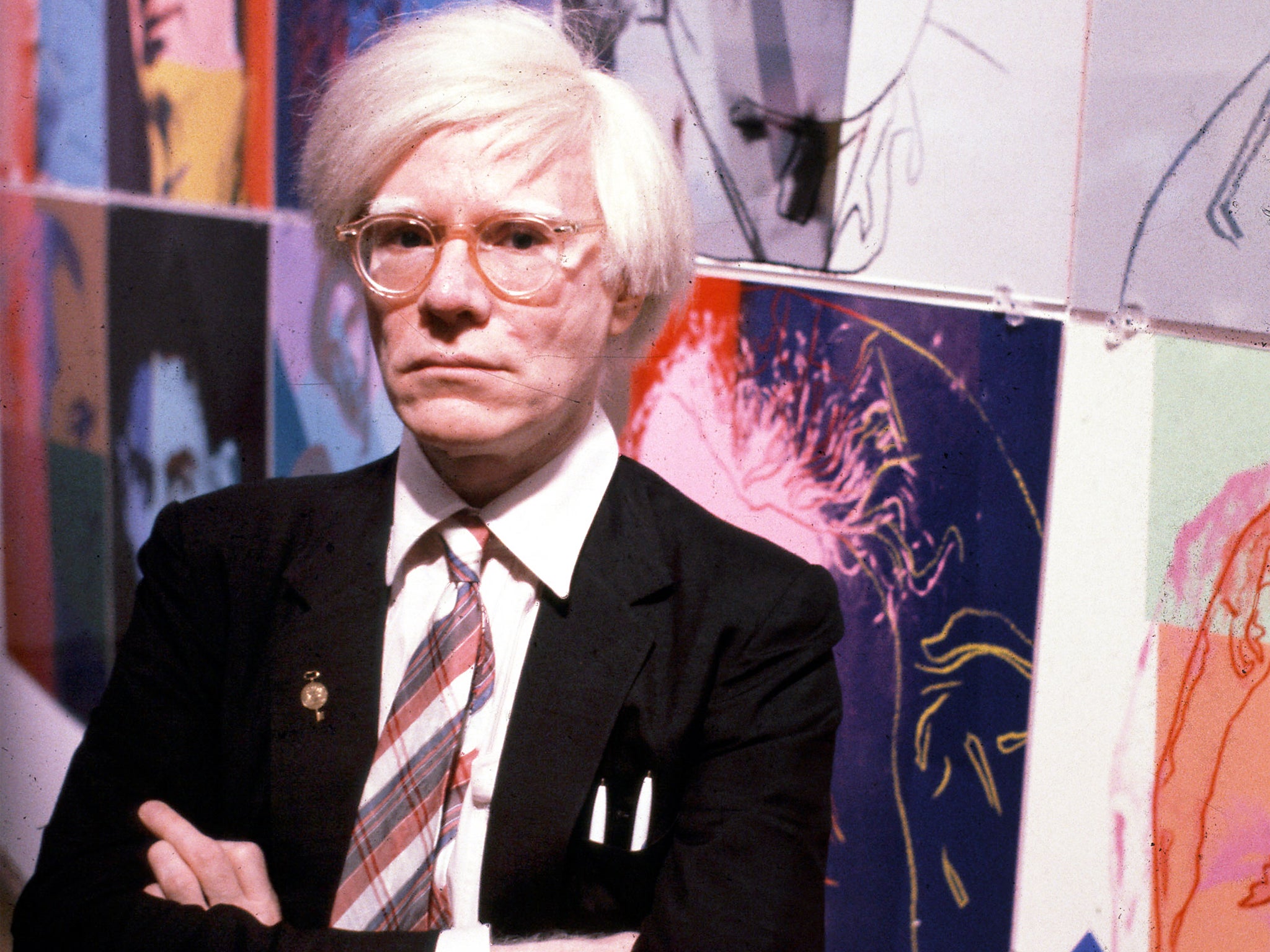
Andy Warhol (/ˈwɔːrhɒl/;[1] born Andrew Warhola Jr.; August 6, 1928 – February 22, 1987) was an American visual artist, film director and producer. A leading figure in the pop art movement, Warhol is considered one of the most important American artists of the second half of the 20th century.[2][3][4] His works explore the relationship between artistic expression, advertising, and celebrity culture that flourished by the 1960s, and span a variety of media, including painting, silkscreening, photography, film, and sculpture. Some of his best-known works include the silkscreen paintings Campbell's Soup Cans (1962) and Marilyn Diptych(1962), the experimental films Empire (1964) and Chelsea Girls (1966), and the multimedia events known as the Exploding Plastic Inevitable(1966–67). https://en.wikipedia.org/wiki/Andy_Warhol
This week marked 37 years since Andy Warhol’s death, but the artist still manages to intrigue us from the grave, especially with his time capsules packed full of objects
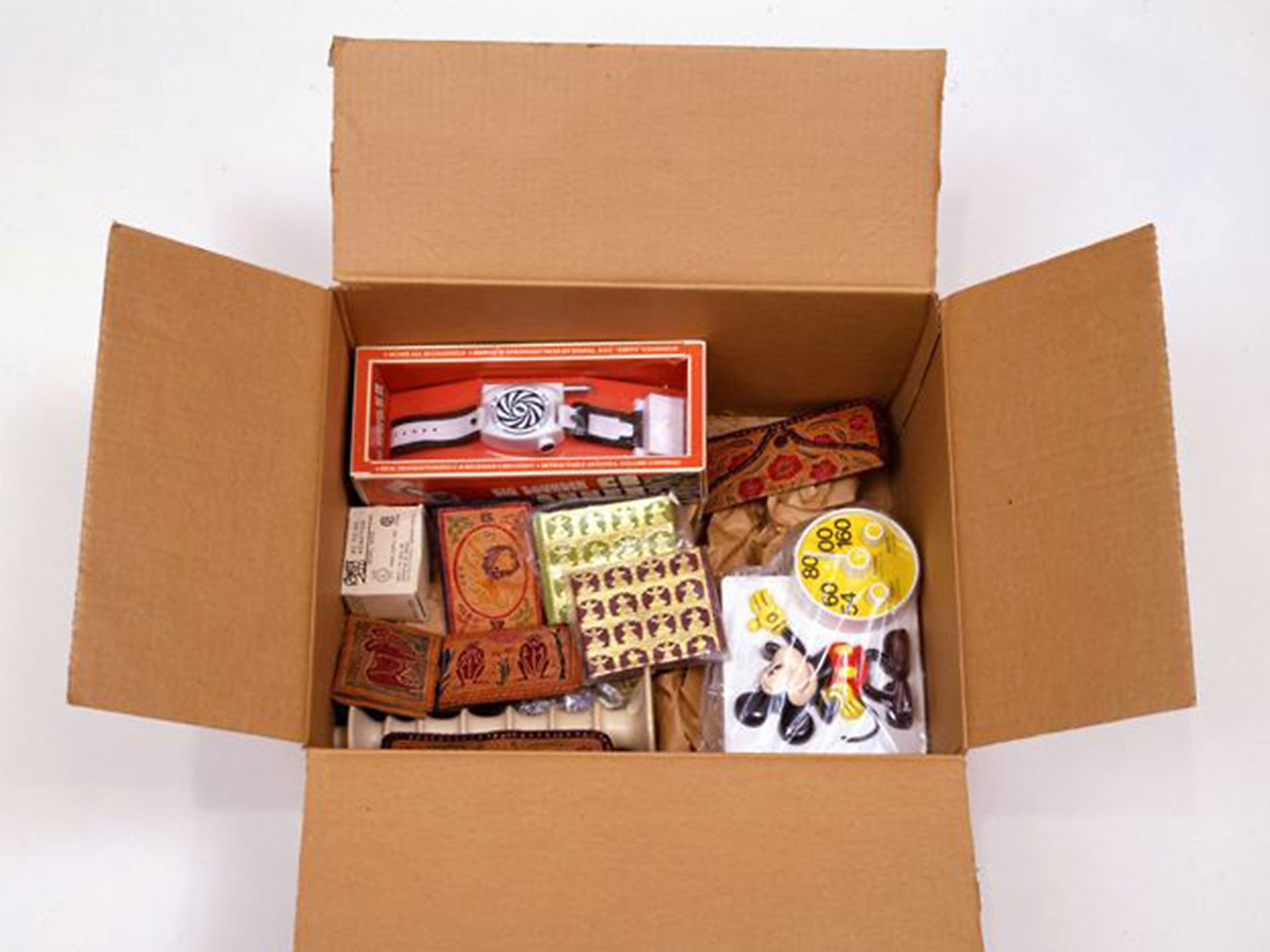
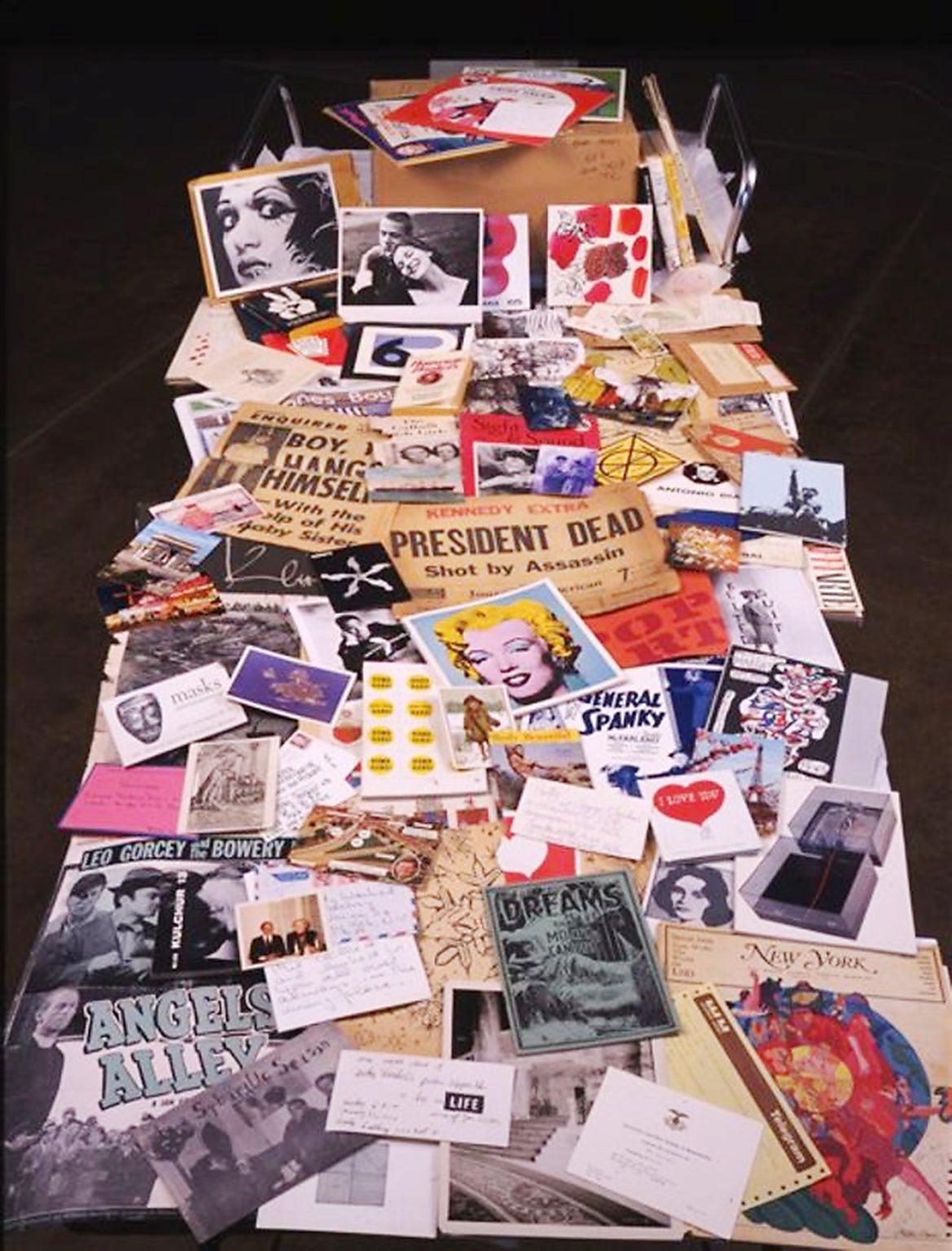
During the last 13 years of his life, Andy Warhol made 610 time capsules. The artist stuffed these parcels with found objects and everyday ephemera, before consigning them to storage.
When the Andy Warhol Museum in Pittsburgh started to carefully exhume and catalogue their contents, they discovered that the boxes contained everything from newspaper articles, junk mail and toenail clippings, through to source photographs for projects, letters for commissions, and even the occasional unsold artwork. The last intact time capsule was opened in 2014 by an anonymous bidder who paid $30,000 (£24,000) for the privilege. It seems safe to say that, 30 years on from his unexpected death at the age of 58 in 1987, Warhol’s work still has secrets to reveal.
This is despite the fact that Warhol has become one of the most well known artists in the world, with endless books and essays devoted to him. His early paintings of the ubiquitous Campbell’s soup cans and iconic silkscreen images of celebrities such as Marilyn Monroe are now instantly recognisable. Warhol currently enjoys an enviable combination of popular appeal, market success and critical recognition. His work is agreed to hold an important place in histories of post-1945 artistic production.
‘Time Capsule 262’ is one of Warhol’s 610 mystery packages (The Andy Warhol Museum)
The latter status stems in particular from Warhol’s experimentation in avant-garde film, with works like Sleep (1963), Blow Job (1963) and Empire (1964). Sleep, famously, has a running time of 521 minutes, and consists of long take footage that shows Warhol’s friend and sometime lover John Giorno sleeping. To make the film, Warhol combined 22 shots, during each of which he homed in on different parts of Giorno’s supine form, from his face to his buttocks. The result is an obsessively voyeuristic film, the overtly boring quality of which paradoxically underlines the intense fascination that the object of desire can hold for an observer.
The cast lists for Warhol’s films, many of which were made at The Factory – the name Warhol gave his New York studio – read like a who’s who of the city’s alternative art scene in the 1960s and 1970s. They feature figures from the worlds of avant-garde film, performance and literature such as Jack Smith, Jill Johnston, Allen Ginsberg, Gregory Corso, Gerard Malanga and Taylor Mead. The Factory itself performed an important networking function, becoming a place for people to be seen as much as for work to be made.
It was also an artwork in its own right. Warhol covered the walls of its first incarnation, which became known as the Silver Factory, in aluminium foil and silver paint, while the overarching concept of The Factory as a creative crucible enabled Warhol to manufacture the “superstars” that appeared in his productions, such as Edie Sedgwick and Ondine, by bringing individuals together and then featuring them in his productions. The Factory provided the stage on which Warhol developed a complex artistic persona that played with the celebrity status of the artist, and with the notion of the artist as impresario, models that practitioners from Tracy Emin to Jeff Koons continue to mine productively.
Warhol’s openness to experimentation continues to ensure critical interest (Getty) (Getty Images/Susan Greenwood/Liaison Agency)
Warhol’s experimentation also expanded into performance. Between 1966 and 1967 he organised a series of multimedia events in collaboration with the Velvet Underground and Nico under the name Exploding Plastic Inevitable (EPI). The EPI immersed its audiences in frenetic environments of slide projections, sound, and strobe lighting. These sensory assaults were disorientating and destabilising, and have come to be understood as radical uses of technology and media.
In a very different instance of artistic collaboration, Warhol let the groundbreaking choreographer Merce Cunningham use his work Silver Clouds (1966) as the scenography for Cunningham’s 1968 dance RainForest. Silver Clouds consists of pillow-shaped Mylar balloons filled with helium that gently float around any given space. In RainForest, the dancers have to negotiate their unpredictable trajectories. The Silver Clouds were themselves developed in conjunction with the engineer Billy Klüver, who headed up the organisation Experiments in Art and Technology during the 1960s.
It is partly this openness to experimentation and collaboration that continues to ensure critical interest in Warhol, but his engagement with sexuality and gender is equally significant. The essays in the 1996 book Pop Out: Queer Warhol exemplify the ways in which Warhol’s work itself, together with his performance of his artistic identity, have had significant ramifications for understandings of the body, queer art histories and sexual politics.
Warhol viewed the time capsules as conceptual artwork in their own right (The Andy Warhol Museum)
Warhol’s reputation has not been unassailable. A dip in the art market in the 1990s led to prices for his works falling, while accusations of misattribution have been levelled at the Andy Warhol Foundation. Yet three decades on from his death, it often seems as if there are as many versions of Warhol as there are audiences.
While it might be the success of his works at auction that make headlines, it is the ideas, creative provocations, and the artist’s own studied resistance to interpretation throughout his interviews and writings which ensure that audiences remain intrigued.
Catherine Spencer is lecturer in modern and contemporary art at the University of St Andrews. This article was originally published in The Conversation
Viva la vida -- Frida Kahlo celebrating #NationalWatermelonDay. The power of the melon x 6
Did you know that watermelon is 92% water? No wonder it’s so refreshing! People have been digging into this tasty, juicy fruit for millennia and it all started in Ancient Egypt. It’s said that watermelon cultivation began in the Nile Valley as early as the second millennium B.C. Watermelon seeds were even found in King Tut’s tomb!
As The National Geographic reported in 2015, the history of the watermelon is muddled. While it’s agreed that it originated in Africa, the precise part of the continent is up for debate. Strangely, even the name of the watermelon we eat today is off. Scientists call it Citrullus lanatus, even though “lanatus” means “hairy” in Latin. The name was originally meant for the cirton melon, which is fuzzy. That fruit is now called Cirtrullus amarus.
The citron melon is a possible watermelon ancestor and grows in southern Africa. But horticulturalist Harry Paris told National Geographic that there is evidence of humans enjoying watermelon that predates farming in southern Africa. For example, there was evidence of watermelon seeds discovered at a 5,000-year-old settlement in Lybia. There’s also evidence that the Ancient Egyptians enjoyed it, since paintings of the fruit have been found in tombs,
Daguerreotype of two men eating watermelon, c. 1855
Cantaloupe and watermelon, 1651, by Giovanna Garzon
Yesterday was #NationalWatermelonDay so here is one, with some other fruits, by Fernando Botero. A little Cotán moment too, with those hanging oranges!
Cape watermelon and gladiola, recorded in 1786 by Jan Brandes.
Albert Eckhout painted the produce of Brazil for his Dutch employers from 1636-1644.
This vine-like flowering plant originated from Africa. While the word watermelon refers to both the fruit and the plant to botanists, the plant is a pepo. The pepo is a berry which has a thick rind (exocarp) and fleshy center (mesocarp and endocarp). Interestingly, pepos develop from an inferior ovary and are characteristic of the Cucurbitaceae.
While the watermelon fruit is loosely considered a type of melon, it’s not in the genusCucumis. The smooth exterior usually has a dark green rind with stripes or yellow spots. The juicy, sweet interior flesh of the fruit ranges from deep red to pink. However, sometimes comes in orange, yellow, or white.
Since the melon holds plentiful water, desert dwellers likely first cultivated the melon. Another reason this is suspected is that wild melons were bitter and tasteless. Additional evidence of the watermelon’s value is supplied in the seeds and art found in tombs of Pharaohs. Over time, cultivation and breeding brought out the better qualities of sweet and tender fruit we enjoy today.
With proper growing conditions, watermelons grow to enormous sizes. Around the world, competitions award prizes each year for the largest one. The Guinness Book of World Records states that the heaviest watermelon weighed 262 pounds. To learn more refreshing watermelon facts, check outwww.watermelon.org.
"I would like to make something that is real in itself, that does not remind anyone of any other thing, and that does not have to be explained—like the letter A for instance." Thus one of America's first abstract painters, Arthur Dove, set up his version of the modernist hope
To be a modern artist in Europe was not the same thing. There, at least in Paris, one had an accessible field of new art. However poor, however rejected or unsuccessful he might be, the Parisian artist could afford to feel that he was part of a continuum known as the avantgarde. In America this was not so; the way to a modernist aesthetic lay through nearly impassable thickets of provincialism, with a very meager supply of information as a guide.
The big problem for artists who did not want to follow the usual pattern of expatriation was how to be both modern and at the same time American. Most modern American art from the teens and '20s had a homemade, do-it-yourself, rule-of-thumb look. Arthur Dove's was no exception, and some of his paintings, particularly in the mid-'30s, poignantly suggest an imagination hobbled by its lack of prototypes. But a certain naiveté and brusqueness were, in any case, bound up with Dove's sense of aesthetic probity. It was part of what he called "going native." Dove was a very American painter: not only did he value his Americanism as such, but he equated it with dynamism, the very principle of modernity. "What do we call 'America' outside of painting?" he asked a friend. "Inventiveness, restlessness, speed, change. Well, a painter may put all these qualities in a still life or an abstraction, and be going more native than another who sits quietly copying a skyscraper."
Dove went to Europe and stayed for two years looking at the work of les Fauves: Matisse, Derain, Vlaminck. He came back in 1909, and never left America again. He could not afford a second trip.
Nature Poet. This meant that his sense of sharing a project with others, crucial to any experimenter, had to be found at home. The only audience was other artists—the group around the "291" Gallery, including John Marin and Marsden Hartley, presided over by Photographer Alfred Stieglitz, who was, in Sherwood Anderson's words, "father to so many puzzled, wistful children of the arts in the big, noisy, growing and groping America." Like other "291" artists, Dove was a nature poet: he never contemplated going to the extreme of "pure" abstraction. "I can claim no background," he once reflected, "except perhaps the woods, running streams, hunting, fishing, camping, the sky."
Dove's death in 1946 and life's work were strongly overshadowed by the advent of Abstract Expressionism.Clement Greenberg, leading critic and fierce proponent ofJackson Pollockand the others, vehemently disliked the work of the Stieglitz Circle artists (with the exclusion ofJohn Marin). In contrast to the post-1945 abstractionists, Dove was considered provincial and a minor talent. Regardless, the influence and fame of Dove, Georgia O'Keffee, John Marin, and others from the Stieglitz Circle continues to grow. Dove has been credited with indirectly influencing the first generationAbstract Expressionists, such asJackson Pollock,Lee Krasner, andMark Rothko, who placed similar emphasis on the artist's subjective experience of his surroundings and on the intrinsic emotional power of color and line. His attraction to the natural world remains a constant in American ar