Showing posts with label Van Gogh. Show all posts

Sunday, June 5, 2022

Gauguin - Sympathy for the Devil


Gauguin - Sympathy for the Devil

How to evaluate Gauguin? In the roll call of 19th century artists, surely he is one of the most diffcult to like as a man. 

His background was exotic - part French, part Peruvian. He was born in France (7 June 1848 - 8 May 1903 but at the age of 18-months, his parents decamped for Peru. His father died on the voyage out, leaving Gauguin's mother to fend for herself.


The family lived for four years in Lima. Gauguin was to claim that Peru's pre-Columbian past was an early influence. After the family returned to France, Gauguin's mother took up with a wealthy stockbroker who financed Gauguin's schooling and later, his own career as a stockbroker. He married a Danish woman, tried his hand at a business career as a tarpaulin salesman. He was not successful and his wife supported the family.

Paysannes bretonnes (Breton peasant women). 1894
In the meantime, Gauguin fathered five children and got "bit" by the painting bug. He studied with Pissarro who was the kindly grandfather/teacher to the obstreperous Gauguin just like he was to Paul Cézanne. Eventually Gauguin left his wife and kids and started on his real artistic odyssey. 


But even Pissarro had his doubts about Gauguin. “He’s not a seer, he’s a schemer,” one-time mentor Camille Pissarro railed, arguing that Gauguin never really lost his capitalist streak; that with his paintings of sun-soaked islands, Gauguin was just cashing in on the Parisian bourgeoisie’s fondness for all things “other”.

Self-portrait with Halo.1889
He was also a genius at self-promotion. He created his own myth in his self-portrait as a Christ-like figure, martyr for an art that no body else appreciated. Early on, he functioned as a guru to a coterie of younger artists and a thief of other mens' ideas and other men's women. The painter Emile Bernard accused Gauguin of stealing his ideas; another, Emile Schuffenecker, accused him of stealing his wife. Van Gogh ended up going for Gauguin with a razor.

 Jacob wrestling with the angel. 

After a stay in Martinique, where he contracted a number of tropical diseases and was returned to France courtesy of the French government's policy of return, he went searching for a new path that would reveal the inner essence of things. In Brittany he found it, “the wild and the primitive... resonating in this granite ground”, though he had gone there initially because living was cheap and credit easy to obtain. It was in Brittany, in a lesson to his young disciple Sérusier, Gauguin gave one of the most seminal talks in the history of modern art. Gauguin asked Sérusier what color the trees appeared to him. “Yellow? Well then, put down the most beautiful yellow on your palette. And that shadow is blue, so render it with pure ultramarine. For those red leaves, use vermilion.”

                               Tahitian Women on the Beach, (1891)

Gauguin told Sérusier to cut out the muddy intermediary colours, to render every colour in its purest and most intense form, straight from the tube – to create what one of Sérusier’s fellow students later described as “a passionate equivalent to every sensation received”.

In the space of a few minutes, Gauguin set in train one of the principal trajectories in the art of the next hundred years, from the Fauvism of Matisse and Derain to the colour fields of Rothko and Barnett Newman – to which might be added the notion that it is the idea behind the work rather than the person who created it that is significant.

"When Sérusier’s fellow students saw the tiny painting that Gauguin had “dictated” to Sérusier on the back of a cigar box – which looked like something Matisse might create 30 years later – they formed a new movement, the Nabis (Hebrew for “prophets”), which included such luminaries as Bonnard and Vuillard. They called the painting 'The Talisman,' venerating it as an icon of the art that was to come."

In 1891, Gauguin left the decadent West for what he romantically imagined was an untouched paradise, the South Pacific islands of Tahiti and Hiva Oa.


                                         Maternity, (1899)

He took three native brides – aged 13, 14 and 14, for those keeping score – possibly infecting them and countless other local girls with syphilis as well as fathering several more children. He always maintained there were deep-rooted ideological reasons for his emigration, that he was quitting decadent Paris for a purer life in a tropical South Seas paradise, but one wonders how pure things really were in the hut he christened La Maison du Jouir (“The House of Orgasm”).

But by this time he was too ill and too disillusioned by the influence of Christian missionaries in his remote Pacific islands to do more than write - and paint his last, brilliant, vibrant masterpieces
.

 Te aa no areois (The Seed of the Areoi), 1892, The Museum of Modern Art

Ever the rebel, Gauguin got into trouble at the end of his life for taking the natives' side against French colonialists. He was sentenced to a month in prison and fined 500 francs.
 Manao tupapau (The Spirit of the Dead Keep Watch)

Suffering from syphilis, he died at 11 a.m. on 8 May 1903 of an overdose of morphine and possibly a heart attack before he could start the prison sentence. His body had been weakened by alcohol. He was 54 years old.

 A 2010 show at the Tate Modern helped to put put him back on the art history tree. By presenting a huge number of paintings, many of them seldom seen, reveals his complex art, a charismatic figure whose influence was greater than we imagined. His themes are archetypes - the woman, the mother, desire, death, fear, obscure, quasi-religious symbols. The paintings became more and more mysterious but Gauguin neither wanted nor felt the need to explain what the meanings were. He remained true to the motto he carve on the doorway of his last dwelling place in the Marquesas Islands: Soyez mystérieuses – Be mysterious.

The vogue for Gauguin's work started soon after his death. Many of his later paintings were acquired by the Russian collector Sergei Shchukin. A substantial part of his collection is displayed in the Pushkin Museum and the Hermitage. Gauguin's posthumous retrospective exhibitions at the Salon d'Automne in Paris in 1903 and an even larger one in 1906 had a stunning and powerful influence on the French avant-garde and in particular Pablo Picasso's paintings
.

Where Do We Come From? What Are We? Where Are We Going?, 1897, Boston Museum of Fine Arts, Boston, MA, USA

In the autumn of 1906, Picasso made paintings of oversized nude women, and monumental sculptural figures that recalled the work of Paul Gauguin and showed his interest in primitive art. Picasso's paintings of massive figures from 1906 were directly influenced by Gauguin's sculpture, painting and his writing as well. The power evoked by Gauguin's work led directly to Les Demoiselles d'Avignon in 1907 Gauguin paintings are rarely offered for sale; their price may be as high as US $39.2 million.

http://en.wikipedia.org/wiki/Paul_Gauguin

Thursday, August 5, 2021

A History of Van Gogh's Starry Night


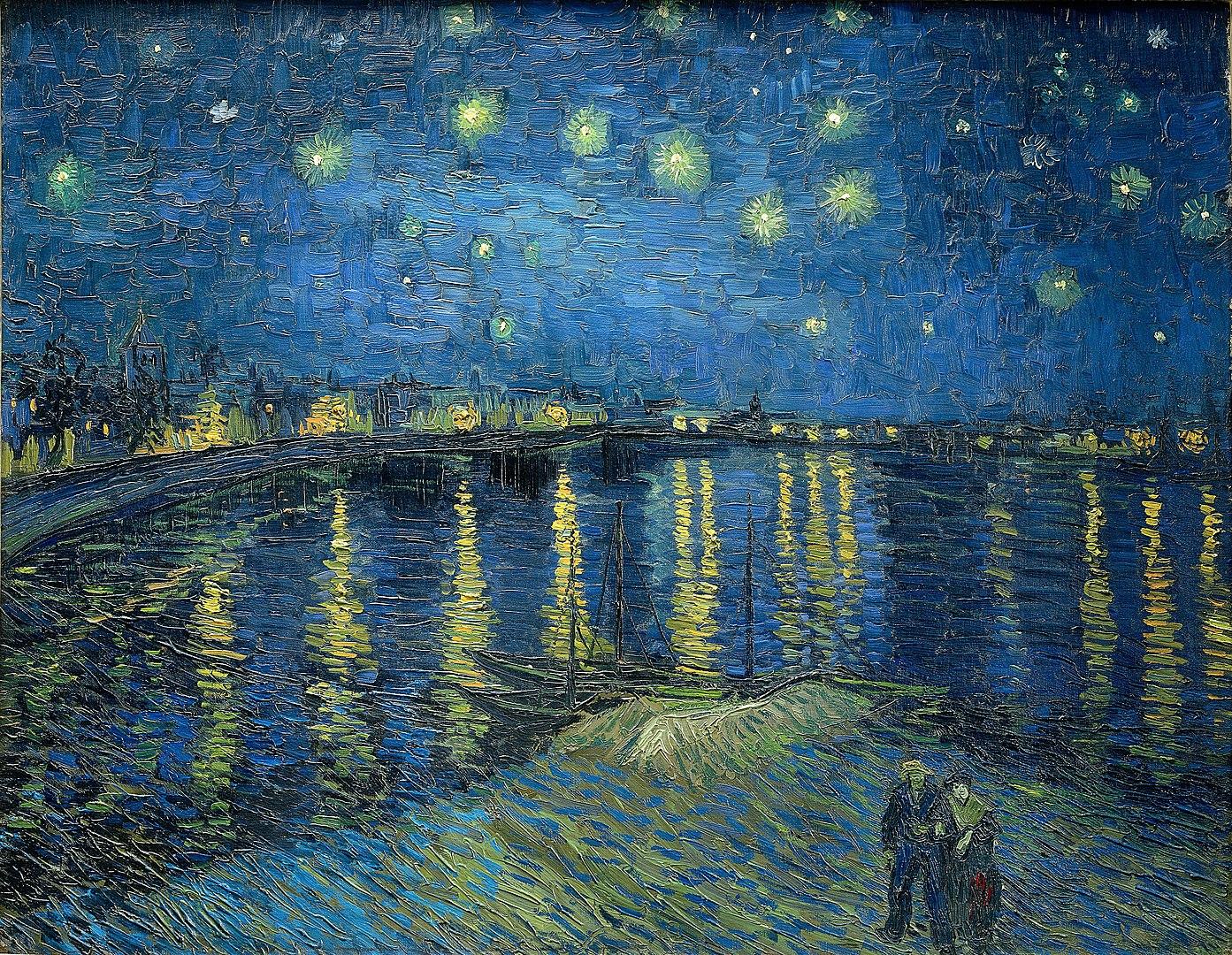
Today, Vincent van Gogh stands as one of the most celebrated artists of the nineteenth century, and his painting, The Starry Night, completed in 1889, is not only one of his most famous works, but also one of the most famous paintings in the world. Yet van Gogh and his beloved painting were not always as famous as they are today. And even today, few people know a great deal about his artistic process. Most are satisfied to know his name and vague 'facts' about his mental health. 

Despite having gained a small measure of acclaim in the two years preceding his death, van Gogh lived most of his life in obscurity. Born in the Netherlands in 1853, van Gogh had been interested in art from a young age and worked as an art dealer for a few years in his early adulthood. However, he spent much of his adult life working in various professions before finally beginning his artistic career in 1880 when he enrolled in classes at the Académie Royale des Beaux-Arts in Brussels.

Though van Gogh only worked as an artist for a decade, he still produced more than 850 paintings and close to 1,300 drawings, sketches, and other works on paper. Yet, despite this large body of work, he only sold a handful of works before his death by suicide in 1890, when he was thirty-seven years old.

WIKIMEDIA COMMONS

Vincent van Gogh, Starry Night (Over the Rhône), 1888. Oil on canvas.

After his death, van Gogh’s collection was left to his art-dealer brother, Theo, who had financially supported him. Theo intended to promote his elder brother’s work after Vincent’s death, but he died just six months after his brother. 

It was Theo’s widow, Jo van Gogh-Bonger—who inherited Vincent’s works and the letters the brothers had written to each other—who would successfully build Vincent van Gogh’s posthumous fame. In addition to publishing the brothers’ letters, van Gogh-Bonger loaned some of her brother-in-law’s paintings to museums for exhibitions while selling others—including The Starry Night.

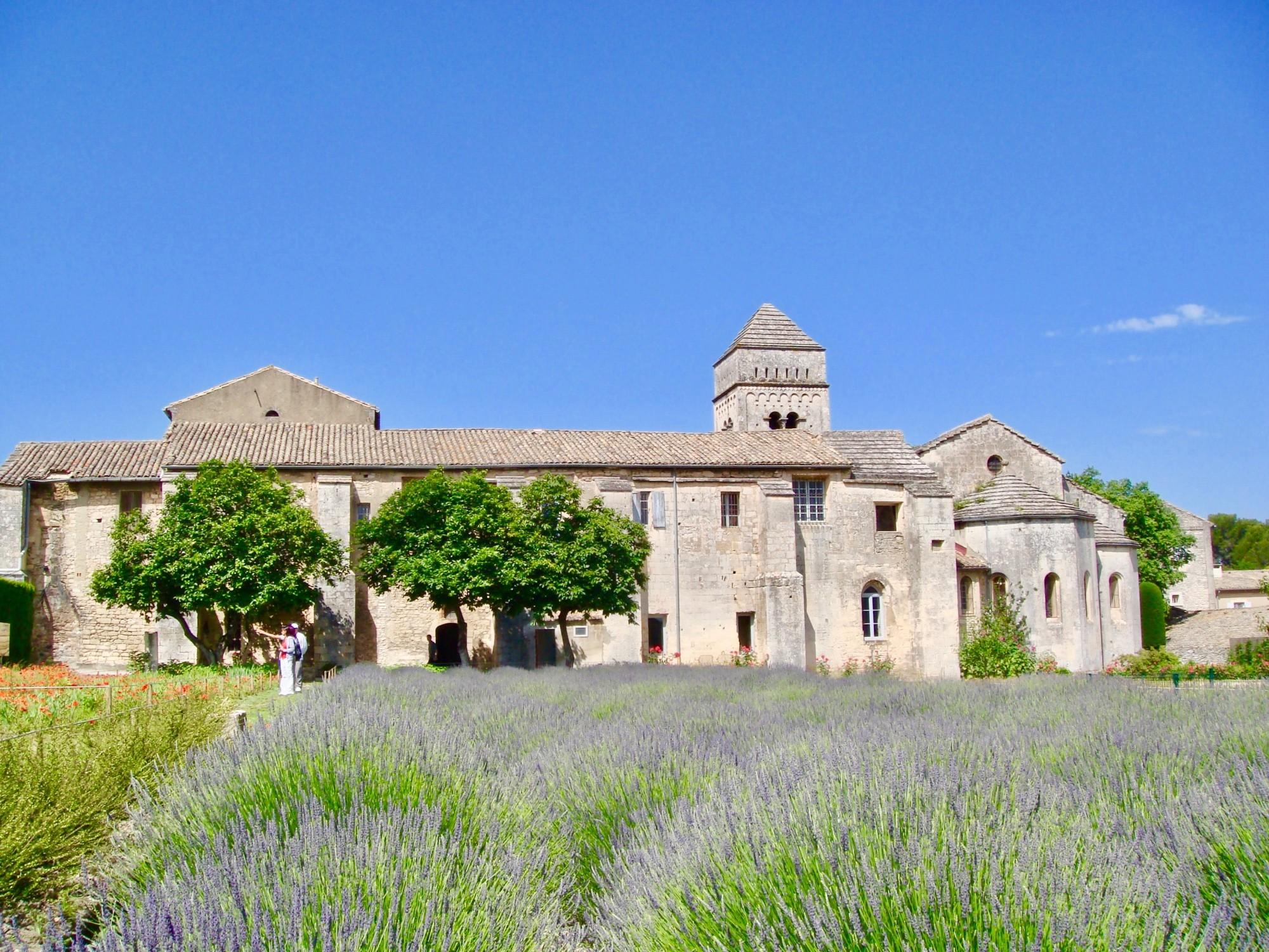
Vincent van Gogh painted The Starry Night in 1889 while he was staying in Saint-Paul asylum in Saint-Rémy, France, where he lived for a year following a breakdown and the mutilation of his left ear. Painted with oil on canvas, the artist attempted to capture the view from the window in his room.

PHOTO BY C.VALDEZ ON UNSPLASH

The Monastery of Saint-Paul de Mausole

On the inspiration for The Starry Night, van Gogh wrote to Theo, “This morning I saw the countryside from my window a long time before sunrise, with nothing but the morning star, which looked very big.”

Though the painter preferred working from observation, he was not allowed to paint in his room, so he began painting the star he had seen in his studio without the view for reference, applying paint to the canvas directly from the tubes to create the image’s iconic thick lines and intense colors. The result was the dream-like image, which features wavy cypress trees in the foreground and glowing stars, a bright crescent moon, a swirling sky, rolling hills, and a village in the background. Some of the elements, such as the mountains in the distance and the existence of the village are true to the view van Gogh would have seen from his window. Meanwhile, other parts, such as the steeple on the church, are imagined.

While van Gogh painted the same view several times with each interpretation appearing different than the last, it is this celestial-inspired image that has captivated viewers for nearly a century. 

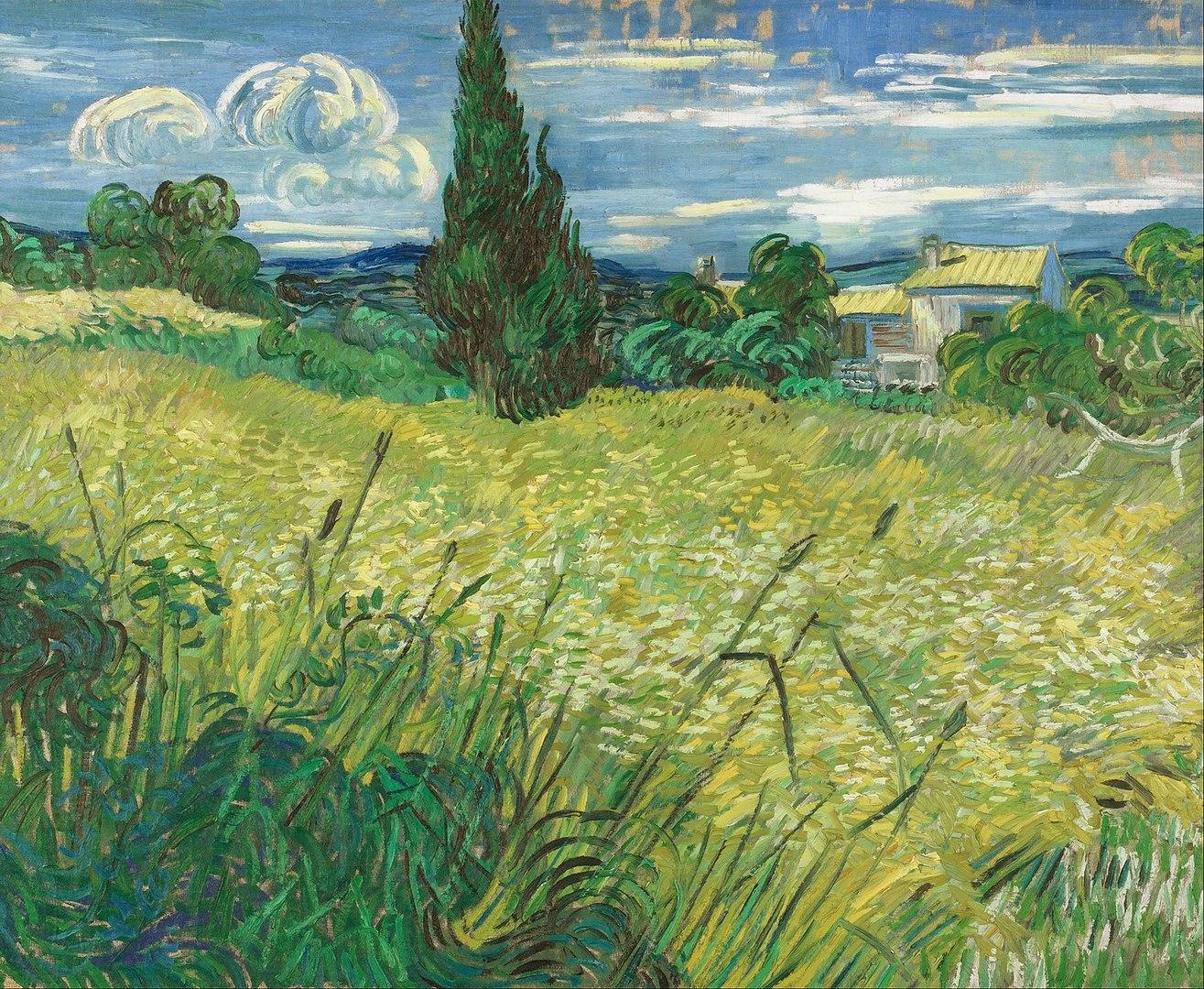
Upon its completion, van Gogh actually believed the painting to be a failure. He wrote to Theo, "All in all the only things I consider a little good in it are the Wheatfield, the Mountain, the Orchard, the Olive trees with the blue hills and the Portrait and the Entrance to the quarry, and the rest says nothing to me."

WIKIMEDIA COMMONS

Vincent van Gogh, Green Wheat Field with Cypress, 1889. Oil on canvas.

Created only a year before his death, The Starry Night is one of the paintings Jo van Gogh-Bonger inherited from her husband. 

She sold it to poet Julien Leclercq, who then sold it to artist Claude-Emile Schuffenecker before van Gogh-Bonger reacquired it and sent it to the Oldenzeel Gallery in Rotterdam. The painting was then sold to Georgette P. van Stolk and then the Paul Rosenberg Gallery, from which the Museum of Modern Art in New York acquired the work in 1941, where it has been housed since. In order to purchase the painting, the MoMA sold three paintings from the collection of Lillie P. Bliss—one of the museum’s founders—which was left to the museum after her death.

Since the MoMA’s acquisition of the painting, viewers have been transfixed by van Gogh’s interpretation of the nighttime view from his window in Saint-Rémy, and The Starry Night now stands as one of the most famous works of Western art.

ABOUT THE AUTHOR

Peggy Carouthers

Peggy Carouthers is a writer, editor, and custom content manager based in California. She enjoys creative writing and learning about art and literature. She is passionate about connecting companies with audiences.

Friday, March 30, 2018

Van Gogh. Born on this day in 1863


Van Gogh, born on this day in 1853 had a terrible start as an artist. In fact, Robert Hughes points out that anybody looking at this early work would not have recognized any talent. His early paintings are drab and somber, even depressing. Yet, after he moved to Paris, his unpromising beginnings matured into a brilliant maturity. His most beloved paintings were made after he moved to Arles in 1888. Although he was tormented by bouts of insanity and was very poor, still he kept on painting. In one of his letters to his brother Theo, he wrote, "I am not strictly speaking mad, for my mind is absolutely normal in the intervals..but during the attacks it is terrible - and then I lose consciousness of everything.But that spurs me onto work and to seriousness, as a miner who is alway in danger makes haste in what he does." 


The outlines of his life are well known - born into a well off Dutch family, he tried many professions, including that of art dealer and clergyman, before deciding to become a painter. His suicide came after years of rejection, mental illness and poverty so it is ironic that he never lived to see his fame and the huge prices that his work commands. By the time of his death in 1890, his work was beginning to attract critical attention and by the beginning of WW I, the Fauves and the German Expressionists considered him a seminal figure in modern art. 

https://www.metmuseum.org/toah/hd/gogh/hd_gogh.htm

https://www.vincentvangogh.org

Tuesday, September 13, 2016

Van Gogh, Grapes


The complementary colors in this work reinforce each other’s intensity. ‘Grapes’ Sept - Oct 1887.

How Van Gogh was portrayed on an episode of Dr. Who: Open Culture


Tuesday, May 20, 2014

Tuesday Grab Bag: Pick Strawberries, Francis Coates, pastel portraits & Expressionism at LACMA


Happy Pick Strawberries Day! Feast your eyes on Flemish painter Jacob van Hulsdonck's c. 1620 work


Francis Cotes RA (20 May 1726 – 16 July 1770) was an English painter, one of the pioneers of English pastel painting, and a founding member of the Royal Academy in 1768. An admirer of the pastel drawings of Rosalba Carriera, Cotes concentrated on works in pastel and crayon (some of which became well known as engravings). After pushing crayon to its limit as a medium—although he was never to abandon it entirely—Cotes turned to oil painting as a means of developing his style in larger-scale works.

http://en.wikipedia.org/wiki/Francis_Cotes

More digital images available for download: http://met.org/1sL9L0u


"Expressionism in Germany and France: From Van Gogh to Kandinsky" sheds new light on the extraordinary response of artists in Germany and France to key developments in modern art in the early 20th century. For the first time in a major museum exhibition, Expressionism is presented, not as a distinctly German style, but as an international movement in which artists responded with various aesthetic approaches to the work of modern masters such as Vincent van Gogh, Paul Cézanne, and Paul Gauguin.

The exhibition features Post‑Impressionist, Fauvist, and Cubist paintings by more than 40 artists—including Cézanne, Van Gogh, Gauguin, Henri Matisse, Robert Delaunay, and Paul Signac—that the Expressionists, such as Wassily Kandinsky, Ernst Ludwig Kirchner, Gabrielle Münter, and Franz Marc, were able to see in landmark exhibitions and collections in Germany and on their travels to Paris. Ninety paintings and 45 works on paper tell the story of the extraordinary cultural dialogue taking place amongst artists of the time.

http://www.lacma.org/art/exhibition/expressionism-germany-and-france-van-gogh-kandinsky

Sunday, March 30, 2014

Matisse's illustrated books at the Legion


Henri Matisse was 60 years old when he began to create original illustrations for livres d’artiste (artists’ books). By the time of his death, 25 years later, he had produced designs for 14 fully illustrated books, several of which are considered 20th-century masterpieces of the genre. View seven of these rare books, including Poésies (1932) and Pasiphaé (1944), in conjunction with the special exhibition Matisse from SFMOMA at the Legion of Honor.

Absolutely delightful animation of one of Matisse's figures from Le Jazz:


More at:  http://www.examiner.com/article/matisse-s-illustrated-books-at-the-legion-and-happy-birthday-to-van-gogh

Tuesday, September 10, 2013

A new Van Gogh discovered

Amsterdam's Van Gogh Museum on Monday unveiled a newly discovered landscape painting from the height of the Dutch master's career, abandoned for years as a forgery in a Norwegian attic. "Sunset at Montmajour," a large oil landscape from 1888, was unveiled to applause by the museum's director Axel Rueger as a "unique experience that has not happened in the history of the Van Gogh Museum."

Depicting a landscape of oaks in the south of France, the painting was brought to the museum from a private collection. Researchers set to work and authenticated it based on comparisons with Van Gogh's techniques, style, paint used and a letter he wrote on July 4 1888 in which he described the painting. It had been lying for years in the attic of a Norwegian collector who thought the painting was a forgery, after buying it in 1908. "This discovery is more or less a once in a lifetime experience," said researcher Louis van Tilborgh, who helped with its authentication.

http://www.nytimes.com/2013/09/10/arts/design/new-van-gogh-painting-discovered-in-amsterdam.html

http://en.wikipedia.org/wiki/Van_Gogh_Museum

Is it a masterpiece? Probably not, although I will never be able to see the original. But it does not stand up to the the incandescent paintings that he made in the last two years of his life.

In a July 5, 1888 letter to his brother Theo refers to the painting:

“Yesterday, at sunset, I was on a stony heath where very small, twisted oaks grow, in the background a ruin on the hill, and wheat fields in the valley. It was romantic, it couldn’t be more so, à la [Adolphe Joseph Thomas] Monticelli, the sun was pouring its very yellow rays over the bushes and the ground, absolutely a shower of gold. And all the lines were beautiful, the whole scene had a charming nobility. You wouldn’t have been at all surprised to see knights and ladies suddenly appear, returning from hunting with hawks, or to hear the voice of an old Provençal troubadour. The fields seemed purple, the distances blue. And I brought back a study of it too, but it was well below what I’d wished to do.”


http://vangoghletters.org/vg/letters/let636/letter.html